Skip to content

Metal Roofing

Metal Roofing for Maine Homes

Decades of protection, built for the coast. Exposed and concealed-fastener systems engineered for Maine snow, salt air, and stiff ocean wind.

Metal roofs sound expensive — and they cost more up front — but spread the cost over the roof's service life and they often beat asphalt on a per-year basis. They shed snow, resist ice dams, stand up to ocean wind, and look fantastic on the right home.

We install both exposed-fastener panels (excellent value for barns, sheds, and some residential) and concealed-fastener systems for higher-end homes. Every panel is coated for Maine's coastal environment, and snow guards are engineered into the layout rather than added as an afterthought.

At a glance

  • Exposed-fastener (R-panel) and concealed-fastener metal systems
  • Kynar 500® and PVDF coatings rated for coastal salt exposure
  • Snow guards engineered and placed for steep Maine pitches
  • Excellent ice-dam resistance and superior wind ratings
  • 40–60 year service life with minimal maintenance
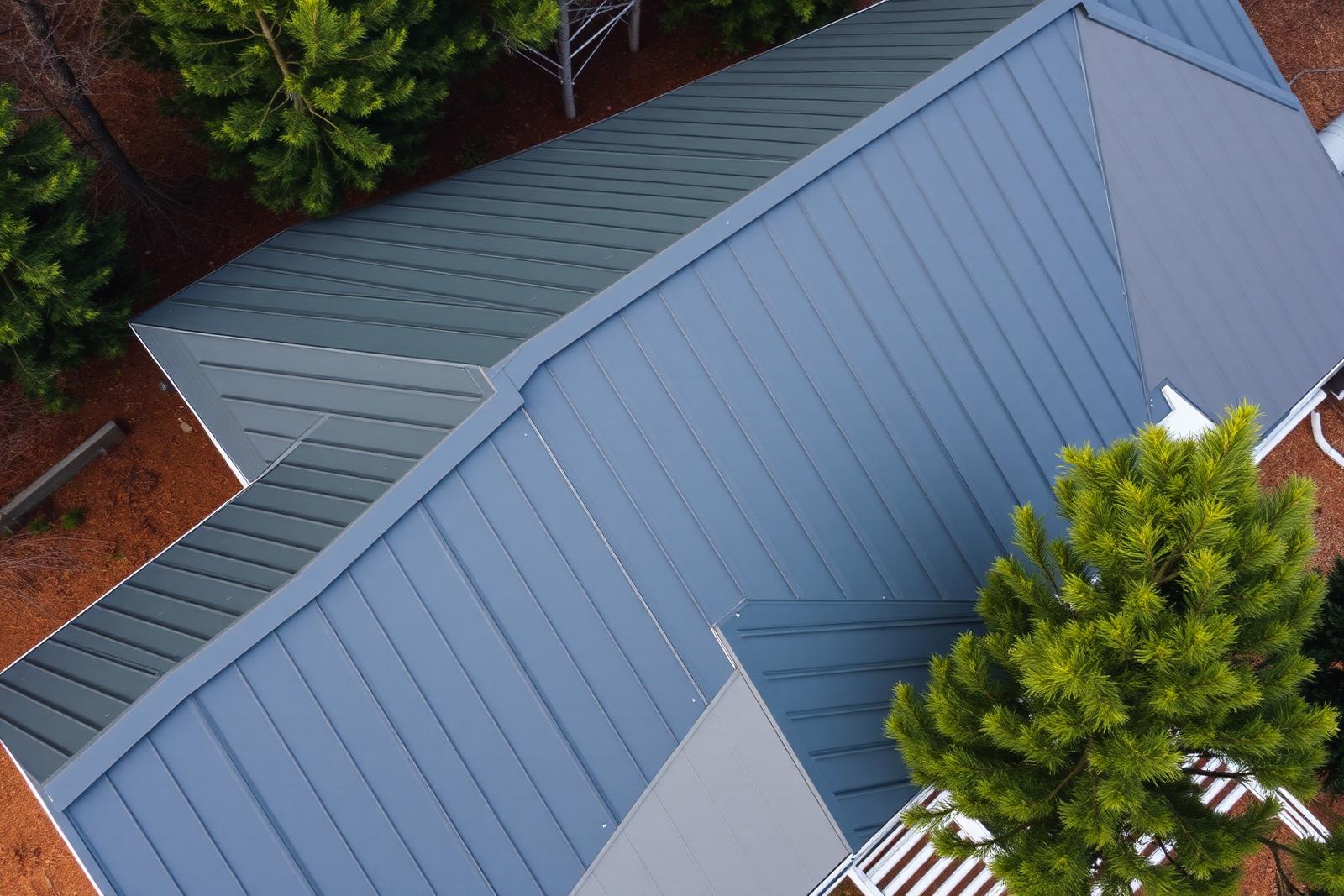
Aerial view of a metal roof on a southern Maine coastal home

What 'metal roof' actually means

Most residential metal roofs in Maine are one of three substrates: Galvalume (steel coated with an aluminum-zinc-silicon alloy — the workhorse), aluminum (lighter, fully corrosion-proof, the right call directly on the coast), or copper (premium, patinas to a green-blue over decades). Each gets a baked-on PVDF topcoat — most commonly Kynar 500® — that carries a 30–40 year warranty against fade and chalk.

Profiles fall into two families. Exposed-fastener panels (R-panel, AG-panel, 5V-crimp) screw down through the face with EPDM-gasketed screws — cost-effective, fast, ideal for outbuildings. Concealed-fastener panels (standing seam, snap-lock) hide the fasteners under the seam — cleaner, longer-lived, the modern residential default. For the deeper standing seam conversation, see our standing seam page.

How we install a metal roof

  1. Full tear-off and deck inspection. Same as every asphalt job. Soft sheathing comes out.
  2. High-temp synthetic underlayment. Metal runs hotter than asphalt; we use underlayment rated for it.
  3. Ice & water shield. Along every eave, valley, sidewall, and penetration — same Maine non-negotiable as on asphalt.
  4. Trim and flashing layout. Eave drip, rake trim, sidewall flashing, valley pans, pipe boots (high-temp silicone for metal), chimney counterflashing.
  5. Panel run. Panels are cut to length on site for a single-piece run from ridge to eave — no horizontal seams in the field on standard pitches. Fastened on the manufacturer's pattern; concealed systems clip-fastened to allow thermal expansion.
  6. Ridge, hip, snow retention. Vented ridge cap where the assembly calls for it, hip caps on hip roofs, and the engineered snow guard layout installed before we move off the roof.
  7. Final walk and cleanup. Magnet sweep, panel film removed, site returned cleaner than we found it.

Why metal works in Maine

Metal sheds snow rather than holding it, which dramatically reduces ice-dam formation. Smooth panels don't trap moss or granule wear the way asphalt does. PVDF coatings shrug off salt spray that would eat painted steel in five years. And metal's wind ratings — typically 140+ mph on concealed-fastener systems — handle nor'easters and coastal gusts without lifting. The catch is snow shedding: on a steep roof above a doorway or walkway, you need engineered snow retention, which we include by default.

Who metal is right for

Coastal homes (Cape Elizabeth, Kennebunkport, Wells, York), steep-pitched homes where snow load is a chronic problem, homes with complex valleys where asphalt seams keep failing, barns and outbuildings, and any homeowner who'd rather pay more once and not think about the roof again for 50 years. Less ideal for very cut-up roofs with many dormers and short panel runs (the labor cost climbs fast) — in those cases composite shake or premium asphalt may be a better value.

Warranty and lifespan

Manufacturer finish warranties on Kynar 500 / PVDF coatings typically run 30–40 years against fade, chalk, and film failure. Substrate warranties on Galvalume run 25–35 years against perforation. Realistic service life: 40–60 years with no meaningful maintenance, longer on aluminum and copper. Our workmanship warranty covers the install itself for the period spelled out in your contract.

Frequently asked

Common questions

How long does a metal roof last in coastal Maine?
A properly installed Kynar 500-coated metal roof in coastal Maine typically lasts 40–60 years. The coating warranty is usually 30–40 years against fade and chalk; the panel itself easily outlives that with no maintenance beyond an occasional rinse.
Is a metal roof louder in the rain?
No. Over a solid wood deck with synthetic underlayment (how we install it) a metal roof sounds essentially the same as asphalt from inside the house. The 'tin roof' sound people remember is metal over open purlins on a barn — a completely different assembly.
Will my metal roof rust near the ocean?
Not with the systems we install. We spec Galvalume substrate (aluminum-zinc-silicon coated steel) or aluminum panels with Kynar 500/PVDF topcoats specifically rated for coastal salt exposure. The finish warranty covers chalk, fade, and film integrity for 30+ years.
Exposed fastener vs. concealed fastener — which should I choose?
Exposed-fastener panels (R-panel, AG-panel) are great value for barns, sheds, garages, and outbuildings, and acceptable on simple residential. The screw gaskets eventually need attention at 20–25 years. Concealed-fastener and standing seam systems have no exposed penetrations, last longer, and look cleaner — the right call for primary residences. See our dedicated standing seam page for that conversation.
Do I need snow guards?
Yes, anywhere snow shedding onto walkways, doorways, decks, A/C units, or driveways would be a problem. We engineer the snow guard layout into the quote — count, placement, and attachment — rather than retrofitting them later.
Can you install metal over my existing shingles?
We don't. We tear off to the deck, inspect and repair, install high-temp underlayment rated for metal, then the panels. Layovers void warranties and hide problems we'd rather find at quote time, not five years in.
Ready when you are

A roof is a long decision. Let's get yours right.

No pressure, no gimmicks. Just a precise quote, an honest conversation, and a roof built for Maine weather.